Interview: Karina Gamez
In La Sensuntepecana, Karina Gamez builds a geography out of what stays in the body. Scent is evidence of the lingering persistence of memory, the way it can outlive the moment that produced it and keep calling you back. From that premise, the piece is built like a palimpsest, with layers of regime and ritual, repression and intimacy, history and the mundane. Written in second person, it holds the urgency of a daughter trying to reach an origin that insists on itself, again and again, until the landscape becomes more than just a place you visit. It becomes an ancestral force you carry.
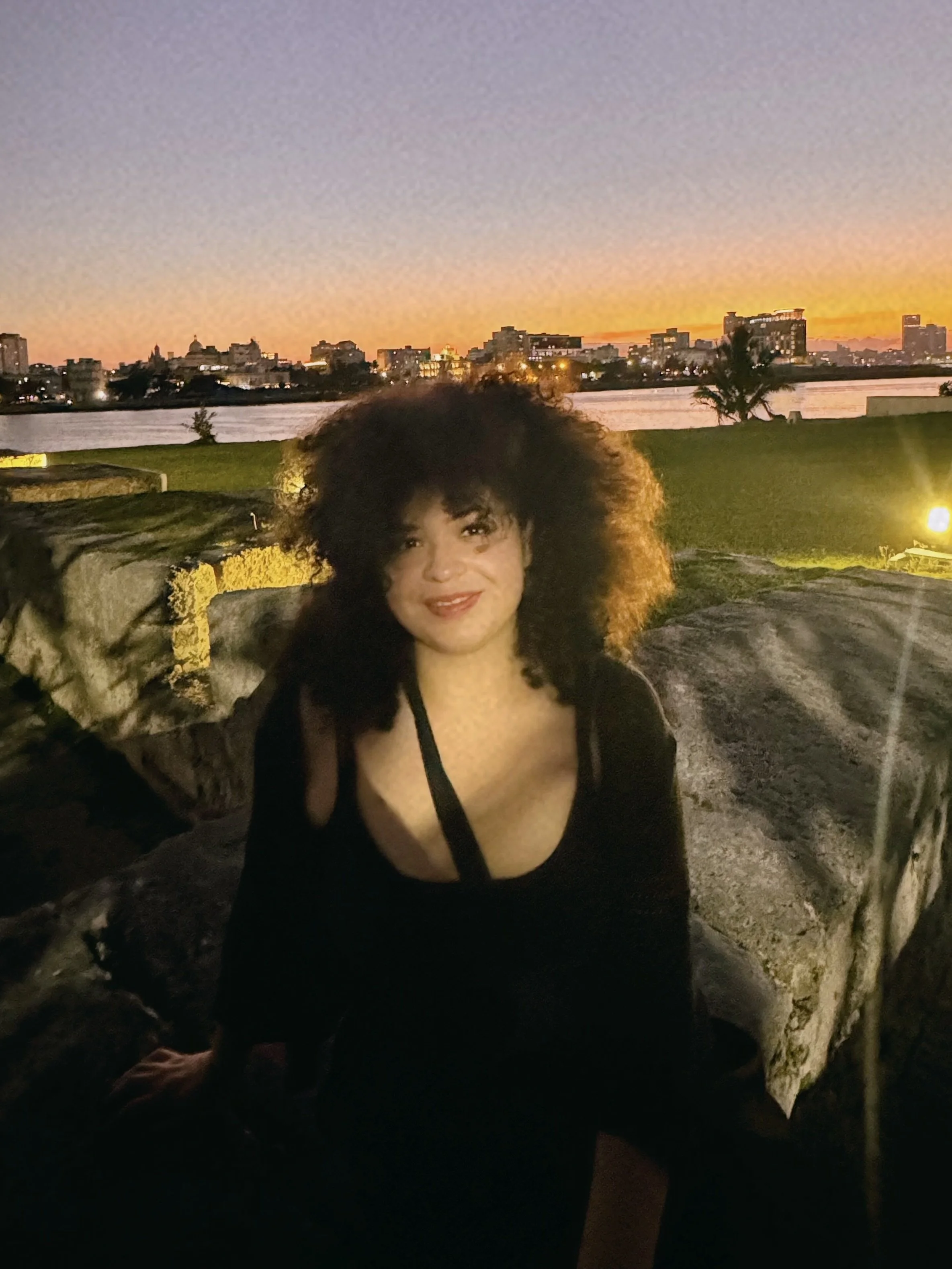
© Karina Gamez
In La Sensuntepecana, scent is a protagonist and a compass. What made you choose smell as the primary way into place, history, and self?
Smell, for me, is the most concentrated out of the five senses, the most enduring. I think, for instance, of the smells in childhood: crayons, cheetos, chlorox in the town swimming pool, old couches, cheap fireworks, hose water, the insides of my lunchbox, the smoky scent of chicharrón con queso leaking from a pupusa on the comal. I think of the cologne my father wore. A musky cologne that he would spray on after a shower. It made him happy. It offered him a feeling of put-togetherness, a preparedness, an armor. It was important to him to put it on before he stepped out the door.
My dad stopped wearing that cologne, only when he physically could not put it on himself anymore. Illness, by which I mean illness with no cure, no treatment, no reassurance, has a distinct scent too. The scent of decay, the scent of death: it is sour. That sourness materialized on my father’s skin weeks before he died from cancer, and then it intensified rapidly, exponentially, in the minutes after he died. And even after he was removed from his bed, after he was removed from our home, transported twenty miles away to the funeral home, that scent lingered on his bed sheets. I washed those sheets, and the scent lingered. I washed them again, and the scent lingered. I returned to college, graduated, got a job, traveled four countries, fell in love, bought a car, fell out of love—and that sour scent, after three years, still lingers.
I chose smell because smell is an experience that outlives its usefulness. There is no reason why that sour smell should still linger on my father’s sheets today. Yet it does. It survives itself. It lives on in its own afterlife.
And with Sensuntepeque, the municipality in El Salvador where my parents were born: I’ve only traveled there three times, and neither time did I dig my nose into its soil. But I know my father did. He toiled in that soil as a child, as an adolescent, as a young man—on that tiny family terrain devoted to the cultivation of maize, beans, and sugarcane as the smoke of a brutal civil war brewed beneath its surface. The smells of his childhood are the smells I ingested undiluted upon arriving to our homeland; the smells with its mixture of memories that passes from my father’s body to mine. That is the compass.
The piece moves through an accumulation of images, voices, and geography, until it feels like the body is being “inhabited” by ancestral memory. How did you decide on that structure?
I was drawn to the image of a palimpsest: a document or manuscript where the original text has been erased in order to be used again for a new text. A surface reworked, altered, but still bearing visible traces of its earlier form. It is essentially a layered artifact of history, and I wanted to map out Sensuntepeque’s terrain in that way, to position it as a site where the old scripts of power—the military regimes, the repression, the arbitrary detentions, the torture, the deaths, but also the resilience, the struggle, the faith, the joy, the intimacies in the utterly mundane—remain legible against the new ones.
That woman in an apron treading down the slope, for example, could be María Feliciana de los Ángeles Miranda who mobilized Sensuntepeque in 1811 and led a revolt against the Colonial Spanish authorities. Or it could merely be my great-grandmother in 1960, selling tamales on the roadside with an infant on her hip.
And that couple kissing, for instance, could be a young couple; two insurrectionists sharing a passionate kiss in 1932 en route west towards the indigenous revolts against the Hernandez Martinez regime. Or it could merely be my mother's first kiss with an older man in 1979, the kind of old man who had never even thought of touching a rifle.
And that military checkpoint, that one could be the one set up in 1981 when Colonel Sigfredo Ochoa Pérez, one of the most violent commanders in the Salvadoran army, descended on Sensuntepeque to cleanse the area of “subversives.” Or it could be the military checkpoint set up in 2023, during the ongoing State of Exception, on the very outskirts of Sensuntepeque, when nine soldiers stopped and surrounded the car I was traveling in.
I wanted, to the greatest extent possible, for the accumulation of Sensuntepeque’s ancestral memory—that physical, emotional, historical palimpsest—to inhabit the protagonist’s body. That is why the piece is also intentionally engineered in second person: to expose a narrator who is, simultaneously, attempting to approach and to distance herself from a place that evokes an unexplainable nostalgia for rhythms, sorrows, pleasures, and terrors that surpasses her comprehension.
How did your drafting and revision process help you arrive at the piece’s intimate cadence, and how did you know when it was ready to let go?
The piece came together quickly, where there was very little time for drafting and revision. I let go, only because I needed to meet the submission deadline.
As for the intimate cadence, it is merely the product of urgency: the urgency of a daughter to experience her origins, to expound upon her yearning for a homeland that doesn’t fully, cleanly belong to her—yet calls out to her, incessantly, again, and again, and again, without rest.
