Alberobello
By Federica Signorini
Issue Two: Nonfiction
Photo by Brigitte Elsner
Shanghai is my chosen city.
No job
No scholarship
No research
No university
A choice of life, facilitated by privilege – some since before the day I was born, even more that I created through the previous cities I inhabited for university, scholarships, research, job, London, Manchester, Atlanta, Mexico City, Bologna, Beijing.
I am still “nella fase di innamoramento”1 as I told a friend recently. As though to downplay my relationship, signalling that I’m aware this won’t last and will likely end in disillusionment.
And I’m keenly aware that I’ve done this, because as somebody newly in love I am conscious of every word I am speaking. Heightened self-awareness, blood rushing, in the way it does when you find yourself searching in the phrases of others for anything that can connect back so that you are talking, still and again, about your love. No topic too far-fetched. I hear her in everything you say. Willing to risk exposing myself by steering us there, no matter how far I have to reach. I love Shanghai, because really, as those of us who have loved a place know, I autoerotically invested in the version of myself that she has shown.
But if a conversation requires openess to the other, listening to the possibility of learning the unknown, then no sooner does a conversation die than when I modify the phrase “I live in China” with the revelation “and I love it” and its followed by the question “but what about…” As though I who have chosen her, I who love her, did not know. Now its my turn to answer but the terms have shifted and I feel myself morphing into defensive position. The feeling that begins in my gut irradiating from the two sets of roots therein firmly planted. Dormant they rest symbiotically but awoken start warring, under strain from the pull of their trunks unravelling, filling the sides of my stomach, branches unfurling pressure in my chest, twigs scratching my oesophagus, desperate for their’s to be the leaves that are illuminated by the light reached via the the orifice of my mouth. I don’t know which has devoured the other until I taste the first word that reveals their genus.
Trachycarpus fortunei
Shanghai’s arboral icon is the sycamore tree.
A man-made hybrid, bred to shed pollution and give a European aesthetic to the Former French Concession neighborhood whose streets they curatedly line. They provide shaded canopies during the unbearable summers, are scaffolds for the fairy lights
that illuminate the streets at night, and backdrops for the city-walks that seduce
most everybody who visits.
Myself included.
But not entirely, because something else has captured my arousal. The Native Windmill Palms are not within the comfort of your eyeline. They require every neck to be tilted back, lips inadvertently parting. While all the images that flood the internet in the spring are of pink and white cherry blossoms, and in autumn the brilliant yellow of the gingko tree, the windmall palm is changing only through growth. They stand proud, resilient, and boastfully clashing with any seasonal landscapes as they survive temperatures as low as -20°c. In winter, while the sycamores are aided by landscapers to maintain appeareances, grooming their branches and clear their leaves hazardly polluting the streets, the windmall plam sways in the wind, armed with its fur jacket. The windmill palm survives and thrives through every season, growing amidst a different landscape with each flowering, shedding, and change. The striking naturally unnatural scene, between the European-North American hybrid and the native Chinese.
Walking in the city on new year’s eve we hear over the silence of the electric cars and scooters, Chinese. And English. And Russian and Arabic and Italian and Korean and Spanish and others that ignorance prevents classification. In China, Shanghai is considered the “International City.” But as I walk down the street one evening, illuminated by the sycamores and gentrification a grandfather walks out of an entrance easily missed, a path that leads to the lane house2 where he lives, his grandson in arms. “你好,小朋友”3 followed by the baby now placed into my arms as 叔叔4 asks if he can take our picture. And now I’m bouncing the baby and smiling and cooing my own infantile Chinese.
A scene that could not exist internationally, and witnessed by my sister in London on facetime left speechless by the confianza and intimacy allowed to exist. The baibai was accompanied by her audible winces as a bike sped past, how could I have my phone out on the street?
A Chinese friend asked me, “What do you think International means?” Here, as in many places, it can so often mean language – English – I immediately think. Because International requires a vantage point from which to view the other, and International, if we’re honest, is a category reserved for the other that does not elicit any “but what about” questions. Then I think of 叔叔5 and the baby.
I think of my community neighborhood where grandparents tell their grandchildren to say hello to 阿姨6, and shopkeepers asking me, now美女,7 how spicy I want my food. I think of heading to our local market, where a woman called over, then changed the direction she was heading in to serve us our usual order of beef tendon, I think of going home late at night, alone, no need to grip keys between the fingers of my now unclenched fist. I think of my husband taking a video of me cartwheeling in the park, asking “where is your bag?” and realising I had left it without a thought unattended in the basket of my bicycle.
With the space that has been liberated from fear in my mind I started to notice that people wear their bags opened, mouths gaping wide even on the metro, and that some designs are made without a thought of how to secure something closed. I think of a video of my mother being reunited with her dog, having just got off the tube. How do I know? I see the excitement in their meeting, and the backpack worn on the front of her body, her arms clasped to its sides uncomfortably.
At the 15th Shanghai Biennale the theme is ‘Can the flower hear the bee?’ a focus on curating dialogue. I read their text: “If a return to the past is impossible…hopeful vision rests on art’s ability to orient us towards an unknown future” My educated instinct was to worry, to fear, leaving the past behind. But what about if only some pasts are forced to be evergreen, forced only to grow tall, to clash with their changing landscapes, while others shed, are groomed, re-framed and re-phrased.
“But what about the palm trees,” I begin to reply. Who even in -20°c can survive? Weathering every season, their evergreen growth an archive of history, a witness to the but what about which came before. ✦
Pinus Pinea
There is a photograph I took of Rome in Rome. The first time I encountered this place it was not yet an archaeological site – although it has since been excavated. It’s not unusual to encounter ruins in this city, but here I saw the disruption of the make believe that is chronology. Unlike the Colosseo these ruins didn’t stand maintained for admiration, unlike the Foro Romano they were not looking down from a hill. These ruins were erupting from beneath the city, their persistence and decay interfering with continuity. Awe and familiarity at how the past of the inside resisted assimilation to the now of the outside. These ruins came from below. But it’s really the trees that struck me. To which layer of time did they still belong? Growing in the interstices, changing, decaying, and molding stratification.
No, for me Rome is not a thought experiment, not a metaphor of visual imagery used as anchor for language to decrypt the feeling of my psychical entity. For me this photograph of Rome in Rome is the answer to a question I am asked every day here in China:
“Where are you from?”
Is today chronological from past to present? Or reverse with the last place lived first?
“I’m from London.”
I’m guilty, I play into it. Revealing that I know you know exactly where that is.
“But my family’s Italian.”
A concession because my name was just exotic enough for you to question my identity. From my accent, you guessed right although you’ll say: “I thought I could see something else in your face” And your hand will move as though to blur it.
“Pero de dónde eres? Porque de Inglaterra, con nombre Federica, y hablas español, como raro.” There again, the same gesture, your hand trying to smooth comprehension.
“And before China I was in the USA.” If the conversation continues I’ll clarify my distance, it’s been a while since I’ve lived in the UK.
All of this my refusal to say “I’m British”.
Because even here, standing in a café in Shanghai, with people from every continent, soy yo la rara. The white British lady who doesn’t meet English expectations.
And it’s right, you should be weary.
“你是哪国人”8
I am quick to say “我是英国人”9 The only language in which I would ever say “I’m English” or rather “I am England’s people”.
Words in English I could never utter. Born and raised in England, nearly a decade ago an ex-boyfriend told a friend of his I was Italian before we met. We met at a pub in London. I was not what he expected, so he said. Never revealing why, I had the pleasure of guessing the expectations he had in mind that my short back and sides and oversized clothing were not meeting.
I imagined then who I am now, the woman in the photograph, or perhaps it was a video that man took of me last week, as I ran on a treadmill. The tight gym wear, sweat dripping down my face, my hair now longer, more “natural” blonde with darker roots. And my tits bouncing up and down.
I wonder which country he thinks I am the people of? Perhaps that was why he took the record, so he could check, confirm with others, circulate the question, open it up for discussion: 她是哪国人?10 Whose people is she?
And to them, I would answer “我是英国人.”11 Because here my privilege is of England’s people. A smile of recognition, willingness to speak more.
But it finally happened, another bar, Shanghai. A Vietnamese-Canadian man.
“You mean Saigon?” no, I really do mean Ho Chi Minh. And there began the conversation I had been waiting for. But there is freedom in the USA. I’m being generous, let me write again, But there is freedom in America. Says a man choosing to live in China for seven years.
Freedom to do what? And so I begin the response I have long rehearsed, a response that began to be formulated in my own United States of American education. “Freedom to harm others” or “Freedom from the harm of others.” His defences were draining, my master’s tools sharpening, but he had one weapon left: “But you are from the UK!” Yes, exactly, finally, now, we’ve reached the topic of conversation those pine trees bring, say it, finish your question: “but what about the Uk’s?” and we can add any moment in the history of violent devastation brough by the British colonial propaganda machine.
But what about the pines? Those pines were brought to Rome by Mussolini. An initiative to make Italy evergreen. ✦
6. Āyí meaning auntie, a familiar name for women.
8. Nǐ shì nǎ guó rén? Where are you from? Literal meaning: you are which country people?
9. Wǒ shì Yīngguó rén. I am from the UK.
10. Tā shì nǎ guó rén. Where is she from? The Chinese characters for “she” and “he” are different, but spoken, they are the same: Tā.
11. Wǒ shì Yīngguó rén. I am from the UK.
Footnotes:
1. Italian for “the honeymoon phase.”
2. Known in Shanghainese as “shikumen” these are clustered three storey terraced housing built in the 20th Century.
3. Nǐ hǎo, xiǎo péngyou. Literal translation: Hello, little friend.
4. Shūshu meaning uncle, a familiar name for men.
5. Ibid.
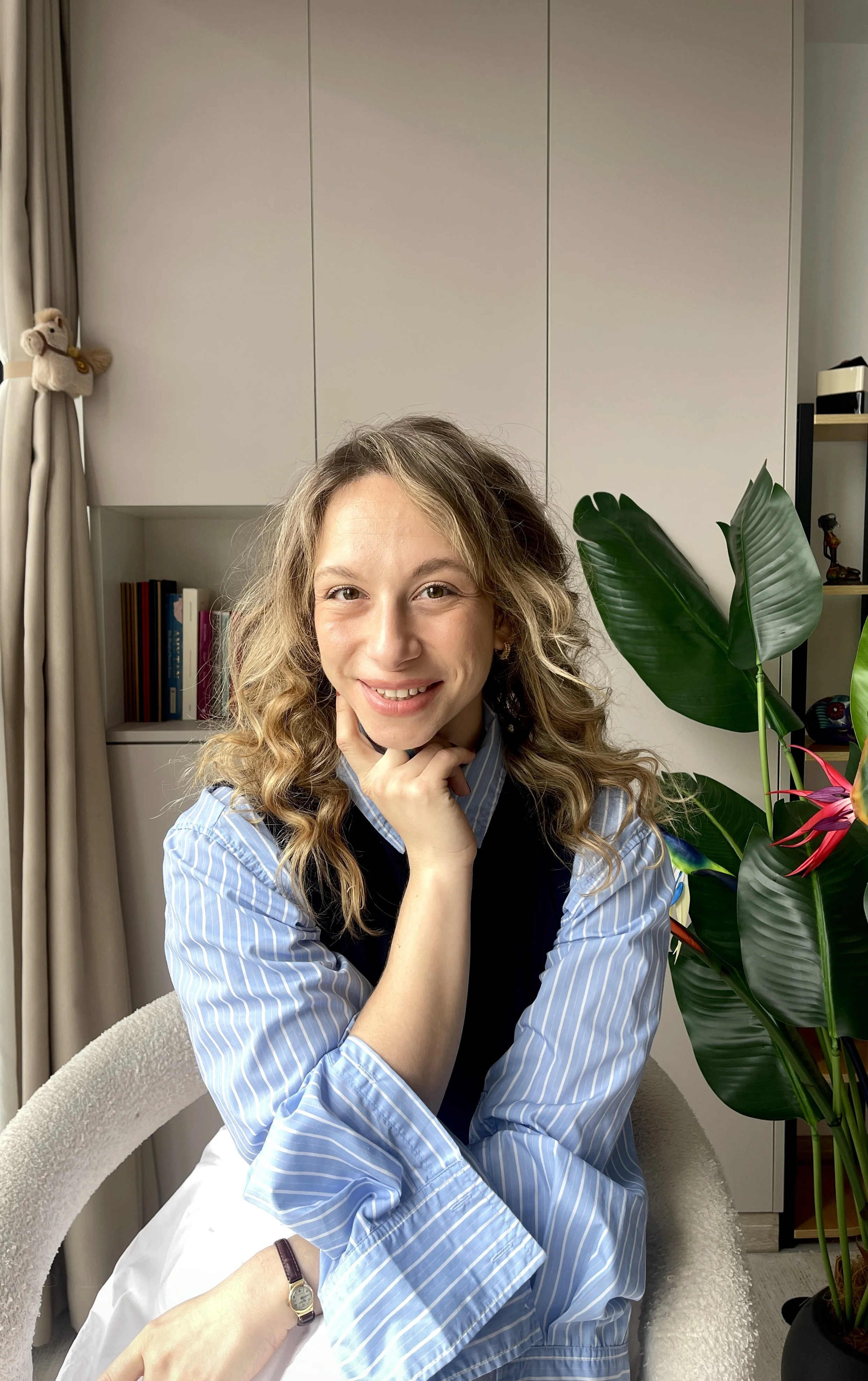
Dr. Federica Signorini is a writer, educator, and independent academic with a PhD in Comparative Literature from Emory University. Informed by a Psychoanalytic approach, her work addresses how identity, colonialism, and trauma affect both intimate and communal relations. After living and working in the U.K, and U.S.A., Federica now resides in Shanghai, China. Here she is the co-founder of TiBa Collective, a narrative strategy consultancy and organizer of writing and mixed-media workshops for creative, academic, and community explorations. She curates @efemmeralia, an Instagram archive of global public art and conversations they provoke.
