Yashica Super 8 mm
By Mojgan Ghazirad
Issue Two: Fiction
Photo by Aedrian Salazar
That night, when we returned from the Leaning Tower of Pisa to the house we’d rented through Airbnb, I felt as though I had stepped into an old home. I hadn’t yet had the chance to explore the house and see how it was arranged—a ritual I’d eagerly performed in every home we’d rented across various European cities over the past two weeks.
It was nighttime, and the soft, milky light in the living room cast a gentle glow over the furniture and objects. How rare, I thought, that this house—unlike the others—was lit with a creamy hue instead of the usual blinding white. Across from the entrance, a built-in wall-to-wall bookshelf transformed into a cabinet at the bottom third—exactly like the design in my grandmother’s living room during the final years of her life. The lace curtains over the windows—both the one opening to the living room and the one hanging in the kitchen—were adorned with large floral patterns and scalloped edges shaped like connected crescents. From the half-open living room window, the sounds of car horns and screeching brakes drifted in. I closed the window and curiously examined the shelves: books on ancient Rome and a few Italian literary works. The kind of books I’d seen in nearly every house—more for decoration than for reading.
But what rooted me to the spot was the old typewriter tucked into the lower corner of the bookshelf, and the handheld video camera placed beside it as a decorative piece.
Years ago, when I was a little girl, I had seen both of these devices in my grandfather’s magical cabinet. The typewriter he had bought for my mother to practice typing—a skill that was popular among girls in the 1970s—had ended up unused in his cabinet. My aunt took it out of its box, fed it a sheet of paper, pressed the keys one by one, and typed the first word in a way that felt utterly magical: Mojgan. I remember it clearly—I was in first grade and hadn’t yet learned all the letters of the alphabet. She said, “Now you write!” and invited me into the wonder of stringing letters together to form words, which at the time felt like the most delightful game in the world. I still remember the bold black ink drying on the paper, turning into a deep brown. And the satisfying scratch of the typewriter as the sentence ended and the carriage was pulled back to the beginning.
The beginning. A fresh start.
I first saw a handheld video camera in my uncle’s hands during the year of the revolution—1979. One afternoon, my sister and I were playing in our grandfather’s garden when he walked in and called out to us. One eye was hidden behind that strange device, while the other looked directly at us. “Mar Mar and Moji, what did you do today?” We stared at him in surprise, and stammered our way through the story of our day. A few nights later, after sunset, my uncle nailed a white sheet to the living room wall and showed everyone the footage of me and Mar Mar playing. It was the first time someone had shown me a film of myself. I watched, endlessly fascinated, as I saw my own face and the way I spoke projected onto the wall. It was the strangest feeling I had ever experienced.
Silent. Wordless. Black and white.
In the Pisa house, naturally, I ran my hand over the film projector. I couldn’t believe that nearly half a century later, I was touching a device so similar to the one my uncle had brought home. A Yashica Super 8mm home movie camera. An Elmo projector. An Agfa camera. The resemblance between this old house and my grandparents’ house was uncanny. Between the objects someone had collected here and the mysterious items my grandfather used to hide in his cabinet. Was the owner of this house still alive? Or had they, like my grandparents, passed away, leaving the home to be rented out by a surviving child? How was it that their belongings so closely mirrored those of my grandparents? How could someone decorate a home thousands of kilometers away in Europe with the same items? Had my grandmother lived a parallel life somewhere else on Earth that I never knew about?
My husband was in the kitchen, boiling water for tea. He called out and said, “Did you know they’ve named this house ‘Grandma’s House’ on Airbnb?”
No, I didn’t. But I didn’t need to know the name to feel my grandmother’s presence. She was right there. Beside that cabinet-lined bookshelf, behind the floral lace curtain, beneath that milky light. Standing there, calling to me:
“Moji! Come, my girl! Your tea’s gone cold!” ✦
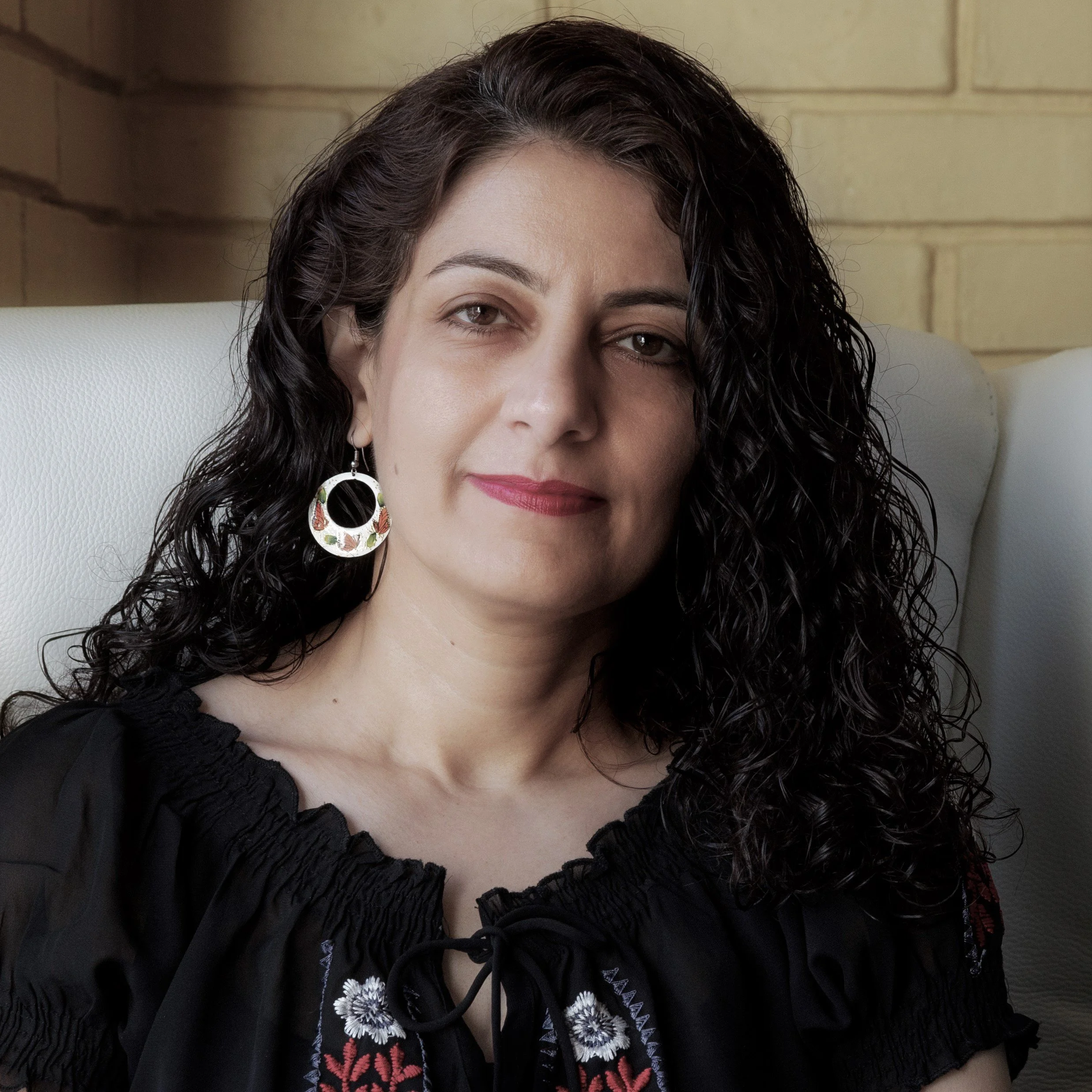
A native of Iran, Mojgan Ghazirad is as an assistant professor of pediatrics at George Washington University Hospital in Washington, DC. Mojgan has published three collections of short stories in Farsi. Her English essays have appeared in The Best American Travel Writing 2020, Michigan Quarterly Review, New Orleans Review, The Idaho Review, Longreads, The Common, etc. She holds an MFA in creative writing and her debut novel The House on Sun Street was published in October 2023. The House on Sun Street was named The Book of the Year for the state of Virginia in National Book Foundation 2024 Great Read from Great Places. It was also picked as the best 100 indie books of the year 2024 for Kirkus Review.
